Libraries
using Pkg; Pkg.activate("docs")
# Import libraries
using Flux, Plots, TaijaPlotting, Random, Statistics, LaplaceRedux, LinearAlgebraThis documentation is still incomplete.
A quick note on the prior
General Effect
High prior precision $\rightarrow$ only observation noise. Low prior precision $\rightarrow$ high posterior uncertainty.
using LaplaceRedux.Data
n = 150       # number of observations
σtrue = 0.30  # true observational noise
x, y = Data.toy_data_regression(n;noise=σtrue)
xs = [[x] for x in x]
X = permutedims(x)
data = zip(xs,y)
n_hidden = 10
D = size(X,1)
Λ = [1e5, nothing, 1e-5]
plts = []
nns = []
opt=Flux.Adam(1e-3)
for λ ∈ Λ
nn = Chain(
Dense(D, n_hidden, tanh),
Dense(n_hidden, 1)
)
loss(x, y) = Flux.Losses.mse(nn(x), y)
# train
epochs = 1000
for epoch = 1:epochs
for d in data
gs = gradient(Flux.params(nn)) do
l = loss(d...)
end
Flux.update!(opt, Flux.params(nn), gs)
end
end
# laplace
if !isnothing(λ)
la = Laplace(nn; likelihood=:regression, λ=λ)
fit!(la, data)
else
la = Laplace(nn; likelihood=:regression)
fit!(la, data)
optimize_prior!(la)
end
_suffix = isnothing(λ) ? " (optimal)" : ""
λ = unique(diag(la.prior.P₀))[1]
title = "λ=$(round(λ,digits=2))$(_suffix)"
# plot
plt = plot(la, X, y; title=title, zoom=-5)
plts = vcat(plts..., plt)
nns = vcat(nns..., nn)
end
plot(plts..., layout=(1,3), size=(1200,300))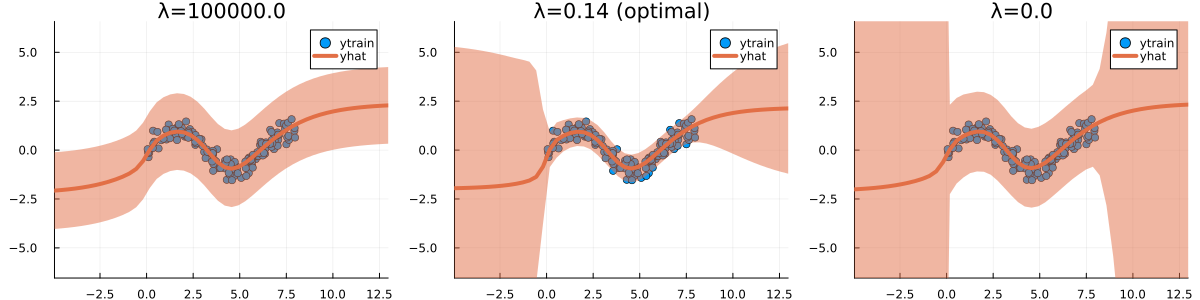
Effect of Model Size on Optimal Choice
For larger models, the optimal prior precision $\lambda$ as evaluated through Empirical Bayes tends to be smaller.
data = zip(xs,y)
n_hiddens = [5, 10, 50]
D = size(X,1)
plts = []
nns = []
opt=Flux.Adam(1e-3)
for n_hidden ∈ n_hiddens
    nn = Chain(
        Dense(D, n_hidden, tanh),
        Dense(n_hidden, 1)
    )
    loss(x, y) = Flux.Losses.mse(nn(x), y)
    # train
    epochs = 1000
    for epoch = 1:epochs
        for d in data
        gs = gradient(Flux.params(nn)) do
            l = loss(d...)
        end
        Flux.update!(opt, Flux.params(nn), gs)
        end
    end
    # laplace
    la = Laplace(nn; likelihood=:regression)
    fit!(la, data)
    optimize_prior!(la)

    λ = unique(diag(la.prior.P₀))[1]
    title = "n_params=$(LaplaceRedux.n_params(la)),λ=$(round(λ,digits=2))"

    # plot
    plt = plot(la, X, y; title=title, zoom=-5)
    plts = vcat(plts..., plt)
    nns = vcat(nns..., nn)
end
plot(plts..., layout=(1,3), size=(1200,300))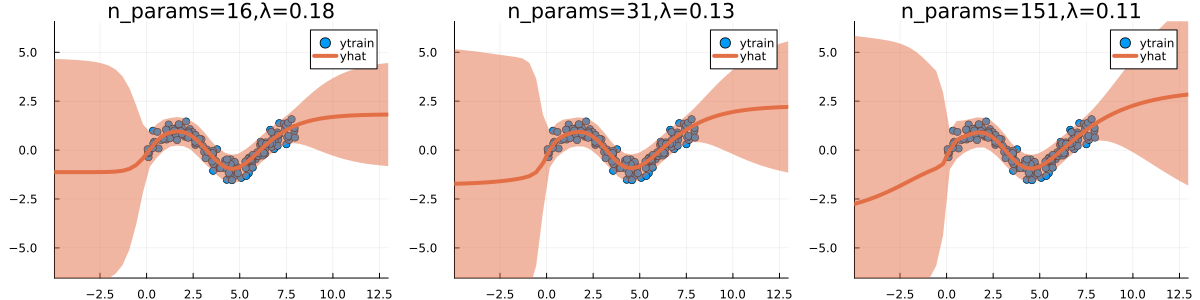
# Number of points to generate.
xs, ys = LaplaceRedux.Data.toy_data_non_linear(200)
X = hcat(xs...) # bring into tabular format
data = zip(xs,ys)

n_hiddens = [5, 10, 50]
D = size(X,1)
plts = []
nns = []
opt=Flux.Adam(1e-3)
for n_hidden ∈ n_hiddens
    nn = Chain(
        Dense(D, n_hidden, σ),
        Dense(n_hidden, 1)
    )
    loss(x, y) = Flux.Losses.mse(nn(x), y)
    # train
    epochs = 100
    for epoch = 1:epochs
        for d in data
        gs = gradient(Flux.params(nn)) do
            l = loss(d...)
        end
        Flux.update!(opt, Flux.params(nn), gs)
        end
    end
    # laplace
    la = Laplace(nn; likelihood=:classification)
    fit!(la, data)
    optimize_prior!(la)

    λ = unique(diag(la.prior.P₀))[1]
    title = "n_params=$(LaplaceRedux.n_params(la)),λ=$(round(λ,digits=2))"

    # plot
    plt = plot(la, X, ys; title=title, zoom=-1, clim=(0,1))
    plts = vcat(plts..., plt)
    nns = vcat(nns..., nn)
end
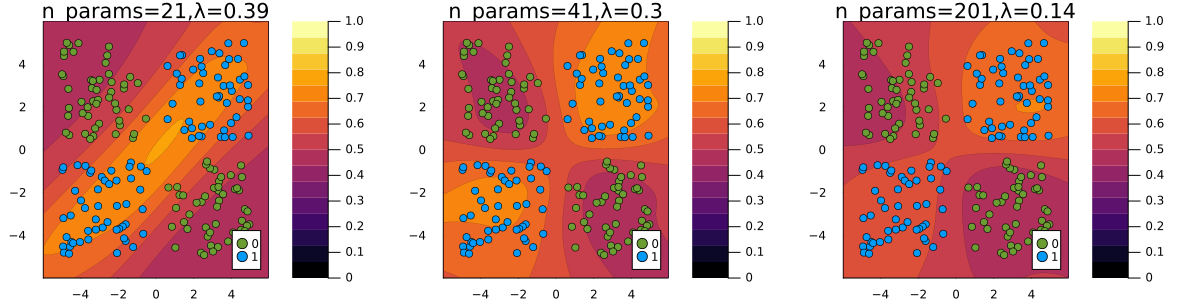
plot(plts..., layout=(1,3), size=(1200,300))